
Designing a Reliable Edge Monitoring Architecture for Smart Infrastructure
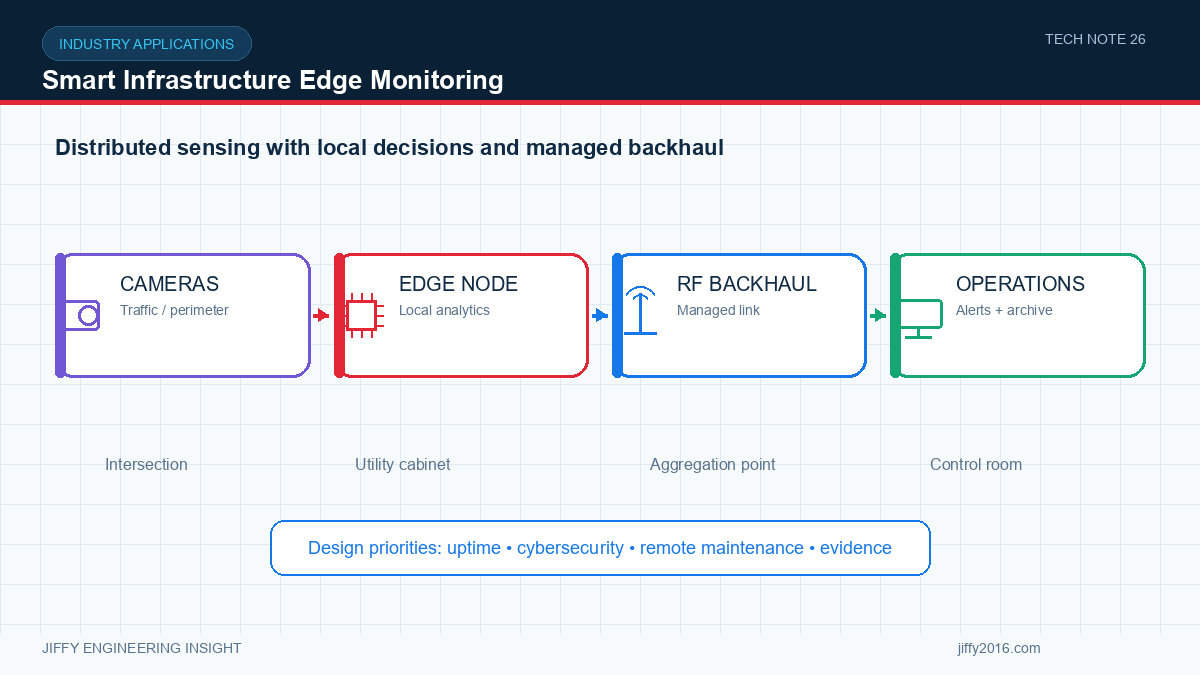
Quick answer: Smart infrastructure monitoring is most reliable when sensing, local processing, communications and operations are designed as one system. Cameras and sensors collect evidence, an edge node filters and analyzes data locally, the backhaul carries prioritized information, and the operations platform manages alarms, health and records. The design should be validated for network loss, power interruption, temperature, storage limits and remote maintenance before deployment.
Smart infrastructure projects often begin with a simple request: add cameras and connect them to a control center. The difficult part appears later, when the system must operate continuously across exposed sites, limited network capacity and uneven maintenance access.
A practical architecture does more than stream video. It decides which information should be processed locally, what must cross the network, how evidence is stored, how faults are reported and how field devices can be serviced without unnecessary site visits.
- Key Takeaways
- Treat the camera, edge computer, RF network and operations platform as one end-to-end path.
- Process time-sensitive events locally and send prioritized results instead of assuming unlimited bandwidth.
- Separate operational traffic, device management and video traffic where possible.
- Design power, enclosure, thermal control and surge protection for the actual installation site.
- Include health monitoring, remote configuration and evidence retention in the initial requirements.
- Start with the Operational Question
- What event must the system detect or document?
- How quickly must an operator receive an alert?
- Is continuous video required, or is event video sufficient?
- What evidence must be retained after an incident?
- What happens if the backhaul is unavailable?
- How often can a technician physically access the site?
- A Four-Layer Reference Architecture
- 1. Sensing Layer
- 2. Edge Processing Layer
- 3. Communications Layer
- 4. Operations Layer
- Local Processing or Central Processing?
- Perform initial detection and event buffering at the edge.
- Send alarms, metadata and selected evidence immediately.
- Send continuous or high-resolution video only when operationally justified.
- Use the central platform for fleet management, cross-site analysis and long-term records.
- Power, Thermal and Environmental Design
- Cybersecurity and Configuration Control
- Suggested Acceptance Tests
- Frequently Asked Questions
- Does every camera need continuous streaming?
- How much local storage is required?
- Where should analytics run?
- What is the most common design mistake?
- Conclusion
“Smart infrastructure” can describe roads, utility corridors, industrial campuses, transport facilities, remote cabinets or distributed public assets. The technology should follow the operational objective.
Useful questions include:
These questions prevent the project from becoming a collection of devices without a defined service outcome.
The sensing layer may combine visible cameras, thermal cameras, environmental sensors and status inputs. Select the lens, resolution and mounting position from the target size and viewing distance, not from a generic camera specification.
For changing illumination or wide outdoor scenes, record test images at the most difficult times of day. A camera that looks good in a laboratory may lose useful detail under backlight, rain, vibration or low illumination.
The edge node receives sensor data and performs tasks such as image preprocessing, event classification, video encoding, temporary storage and device health reporting. Local processing reduces the amount of data sent over the network and can preserve response time during temporary backhaul loss.
The edge platform must be sized for peak concurrency. Four cameras may each be easy to process alone, yet create memory, thermal and network bottlenecks when all streams run at once. Validate the complete pipeline under continuous load.
The communications layer may use point-to-point, star or managed multi-node RF links depending on geography and traffic flow. Calculate the link from antenna position, path clearance, interference and required availability. Nominal radio range is not an acceptance criterion.
Traffic should be prioritized. Alarms, device health and control messages usually deserve higher priority than background video or bulk file transfer. Define what the edge node stores locally when the network is unavailable and how data is synchronized after recovery.
The operations platform presents alarms, live views, historical evidence and device status. It should also support configuration control, user permissions, audit records and maintenance workflows.
An operator needs to know whether a missing image is caused by the camera, the edge node, the network or the central platform. Layered health reporting makes that diagnosis possible.
Neither approach is universally correct. Local processing is useful when latency must be low, bandwidth is limited or the site must continue operating during network loss. Central processing can simplify model management and combine data from many locations.
A hybrid architecture is often the most practical:
The partition should be documented so that every function has a clear owner and failure behavior.
Outdoor cabinets create a thermal system around the electronics. Solar loading, sealed enclosures, heat from power converters and reduced airflow can raise internal temperature far above the weather report.
Build a power budget for normal operation, startup, heater or fan loads and radio transmit peaks. Add protection for supply transients, incorrect wiring and surge paths appropriate to the installation. If the site uses battery or solar power, include the duty cycle of cameras, illuminators, radios and edge processing.
The acceptance test should run the real workload at the worst expected ambient condition. Monitor processor temperature, throttling, dropped frames, radio stability and enclosure temperature.
Distributed infrastructure is difficult to maintain when every device has a different password, firmware image or configuration. Use unique credentials, role-based access, encrypted management paths and controlled release records. Disable unused services and document recovery procedures.
Firmware, RF settings, application software and device configuration should be treated as one tested release. A known-good rollback package reduces risk when a field update fails.
| Test | Evidence to Record | Typical Pass Condition |
|---|---|---|
| Image quality | Day, night and difficult-light samples | Required target detail remains visible |
| End-to-end latency | Event timestamp to operator display | Within the operational response limit |
| Backhaul interruption | Disconnect and restore the link | Local operation continues and recovery is controlled |
| Peak workload | All streams, analytics and recording active | No unexplained frame loss or thermal throttling |
| Power recovery | Controlled interruption and restart | System returns to the approved state |
| Device health | Camera, edge and radio faults | Fault source is identifiable remotely |
No. Event-driven streaming, lower-rate background video or local recording may provide the required evidence with much lower network load. The decision should follow the operational need.
Calculate it from video bitrate, number of streams, retention time and expected network outage. Reserve additional capacity for event clips, logs and file-system overhead.
Run time-sensitive or bandwidth-reducing functions at the edge. Use central resources for fleet-wide management, long-term analysis and tasks that require data from multiple sites.
Sizing each component independently. A successful project validates the full path from sensing and power through edge processing, backhaul and operator response.
Reliable smart infrastructure monitoring is an integration problem. The strongest design connects the operational objective to a measurable sensing, computing, communications and maintenance architecture.
Jiffy supports industrial camera modules, wireless connectivity, RF front ends and edge computing platforms for system integrators and equipment manufacturers. Contact market@jiffy2016.com or visit www.jiffy2016.com to discuss interface, power, thermal and link requirements.
Discuss your system requirements with Jiffy
market@jiffy2016.com | www.jiffy2016.com
Subscribe to Our Newsletter
Your Email*
*Country*
*Verification code


