
Point-to-Point, Star or Mesh - Choosing an Industrial Wireless Topology
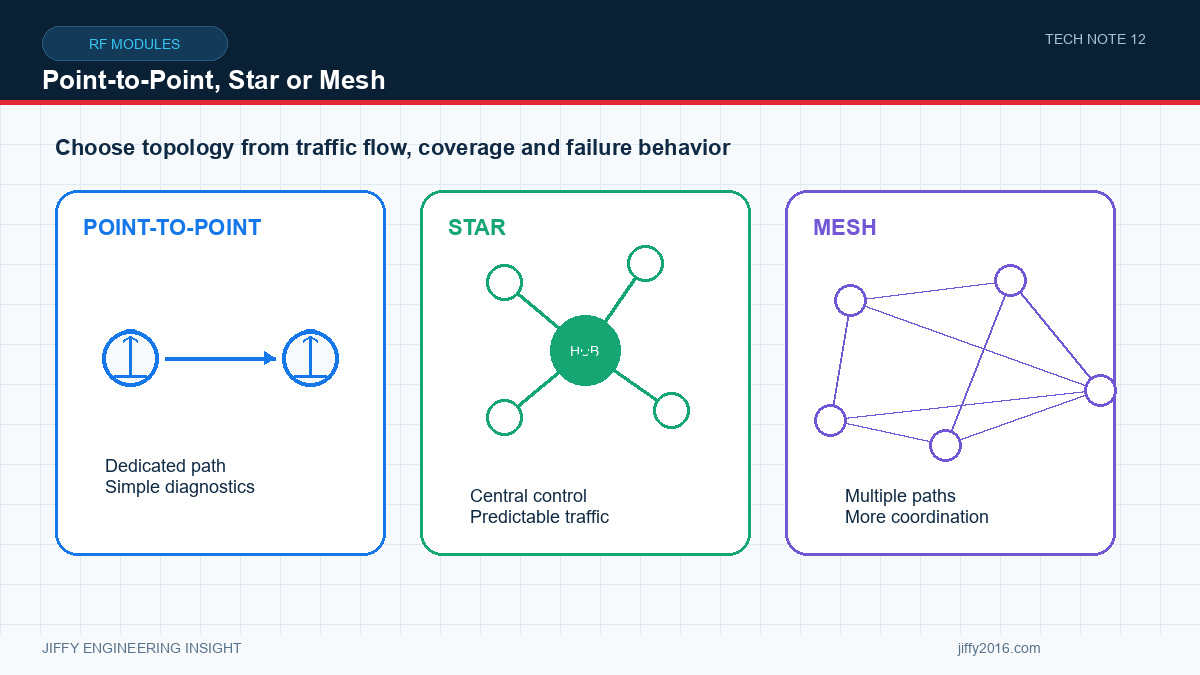
Quick answer: Point-to-point wireless connects two endpoints with simple, predictable traffic. A star network connects many nodes through a central coordinator. A mesh lets selected nodes relay traffic for others. The right topology depends on node count, mobility, traffic direction, latency, route stability, coverage and failure recovery—not coverage alone.
Topology determines how traffic moves, which device coordinates the network and how a failure changes the path. Choosing it early prevents an RF module from being integrated into a network model it cannot support efficiently.
- Key Takeaways
- Point-to-point offers the simplest path and easiest latency analysis.
- Star networks simplify endpoint logic but depend on the coordinator and its coverage.
- Mesh can route around some obstacles but adds routing traffic and uncertainty.
- Capacity must be calculated from application traffic plus network overhead.
- Test node loss, movement and reconnection before production.
- When is point-to-point appropriate?
- How does a star network work?
- What does mesh add?
- Compare the application requirements
- Maximum and typical node count
- Fixed or mobile nodes
- Uplink, downlink and peer-to-peer traffic
- Average and peak payload rate
- Maximum acceptable latency and jitter
- Required recovery after a node or path fails
- Coverage geometry and installation constraints
- Power limits for each node
- Central management and firmware-update needs
- Capacity and latency
- Failure and recovery
- Decision checklist
- Use point-to-point when two endpoints and predictable behavior dominate.
- Consider star when central coordination and many simple endpoints fit the site.
- Consider mesh when relaying creates real coverage value and traffic can tolerate its overhead.
- Reject any topology that cannot demonstrate required capacity and recovery under the full node load.
- FAQ
- Does mesh always extend range?
- Is star suitable for mobile nodes?
- Can one product support more than one topology?
- Conclusion
Point-to-point suits one equipment link, one mobile-to-base connection or a dedicated bridge. With only two endpoints, addressing and routing are simple, and throughput and latency are easier to predict.
Its limitation is scale. Adding more devices may require separate links, time sharing or a different architecture. Define whether future expansion is likely before fixing the host interfaces and antenna plan.
In a star, endpoints communicate through a central coordinator, gateway or base. The coordinator can manage timing, configuration and upstream traffic. Endpoints may be simpler because they do not relay packets for others.
The central node needs capacity for combined traffic and suitable coverage for every endpoint. Its failure affects the whole network, so power, redundancy and placement deserve special attention.
A mesh allows traffic to travel through intermediate nodes when direct paths are unavailable or weak. This can improve route flexibility in distributed infrastructure, but it consumes airtime for relayed traffic and introduces route discovery, maintenance and recovery behavior.
Mesh is not automatically better for mobile or high-throughput systems. Frequent movement can cause routes to change, and every additional hop can add latency and reduce shared capacity.
Document:
The topology should be selected from this model rather than from a drawing of the site alone.
Radio data rate is not application capacity. Include packet headers, acknowledgements, retransmissions, routing messages, channel access and firmware-update traffic. In a mesh, relayed traffic may occupy the channel more than once.
Test peak simultaneous traffic. A network that performs well with one active node may become congested when alarms, status reports or video streams occur together.
For each topology, define behavior when the central node restarts, an endpoint loses power, an intermediate mesh node disappears or interference blocks one channel. Measure how long the network takes to return and whether queued application data is duplicated, delayed or lost.
It can extend reach through relays, but only when intermediate nodes have suitable paths and capacity. It does not remove antenna, spectrum or interference constraints.
Yes, when the coordinator covers the movement area and the protocol handles reconnection and changing link quality within the required time.
Some platforms can, but interfaces, firmware, capacity and validation differ. Treat each supported mode as a defined configuration.
Topology is a system behavior, not only a network diagram. Select it from traffic, latency, mobility, capacity and recovery requirements, then validate the full node count and failure cases.
Discuss your system requirements with Jiffy
market@jiffy2016.com | www.jiffy2016.com
Subscribe to Our Newsletter
Your Email*
*Country*
*Verification code


