RK3588 Four-Camera Edge Computing Platform for 360° Perception and Autonomous Navigation
A high-performance multi-camera architecture for visual SLAM, obstacle detection
RK3588 Four-Camera Edge Computing Platform for 360° Perception and Autonomous Navigation
Robots operating in warehouses, factories, campuses and outdoor facilities must process several types of information at the same time. They may need to detect people, estimate free space, build a map, recognize signs, record video and communicate with a central management system.
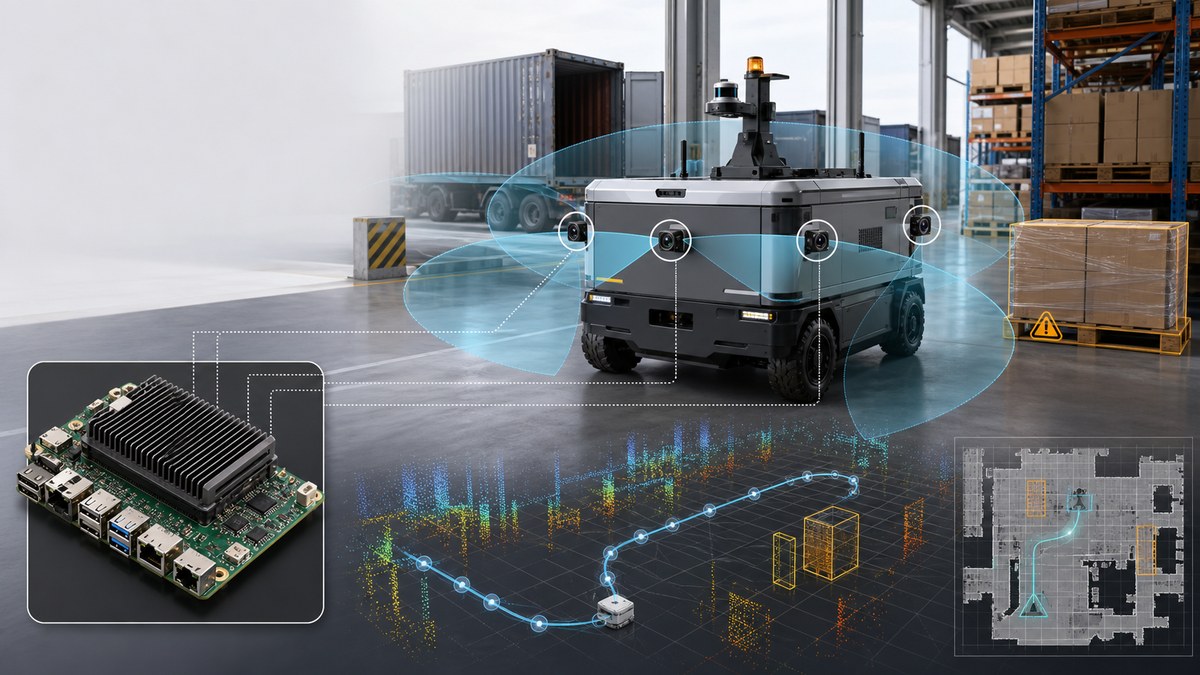
A four-camera edge computing platform based on the Rockchip RK3588 provides the processing resources required for these concurrent workloads. Its eight-core CPU, Mali-G610 GPU, 6 TOPS NPU, multi-camera input capability and high-performance multimedia engines make it suitable for advanced visual perception at the edge.
Why RK3588 for Multi-Camera Robotics?
The RK3588 is designed for applications that require more computing and multimedia performance than a basic embedded controller can provide.
For a four-camera robot system, available computing resources can be divided across several tasks:
Camera capture and image signal processing
Lens correction and image stitching
Object detection
Semantic segmentation
Depth estimation
Visual SLAM
Local map generation
Video encoding and recording
User-interface rendering
Network communication
Robot-management software
The NPU can accelerate supported AI models while the CPU handles navigation logic, communication and system management. The GPU can assist with graphics, image processing and compatible compute workloads.
Four-Camera Layout Options
There is no universal camera layout for autonomous navigation. The arrangement should be selected according to the platform’s shape and intended operating environment.
Surround-View Configuration
Front, rear, left and right cameras provide broad environmental coverage. This arrangement is suitable for larger AMRs, inspection vehicles and machines that frequently move in different directions.
Stereo-Forward Configuration
Two overlapping front cameras provide stereo depth, while the remaining cameras monitor the sides or rear. This configuration is useful when forward obstacle distance is especially important.
Navigation and Inspection Configuration
Two cameras handle navigation, while the other two observe equipment, shelves, meters or infrastructure. This allows one computing platform to support both mobility and inspection functions.
Wide-Angle Panoramic Configuration
Four wide-angle cameras can be calibrated and stitched into a surrounding view. The result can support remote supervision, blind-area monitoring and improved situational awareness.
A Practical Perception Pipeline
A four-camera RK3588 system generally processes data through several stages.
First, the cameras capture overlapping or direction-specific images. The software corrects lens distortion and applies calibration parameters. The processed frames are then passed to AI and geometric-vision algorithms.
Object-detection networks can locate people, pallets, vehicles and equipment. Semantic-segmentation models can classify floor, walls, roads and restricted areas. Depth can be estimated through stereo vision, multi-view geometry or compatible neural networks.
Visual features and motion data are then used for localization or SLAM. The results are converted into maps, obstacle lists or traversable-space information for the route planner.
This division of work is important: the perception system identifies the environment, while the navigation and safety controllers determine how the machine should move.
Supporting Obstacle Avoidance
Four cameras can help detect obstacles that a single forward camera may miss. For example, side cameras can monitor clearance when turning, while a rear camera can protect reversing and docking operations.
The system may perform:
Person and vehicle detection
Pallet and package recognition
Floor-boundary detection
Static and moving obstacle classification
Free-space segmentation
Distance estimation
Blind-area monitoring
Docking-target recognition
Camera-only perception can be effective in many controlled environments, but lighting, reflections, fog, dust and textureless surfaces can reduce performance. Industrial systems should therefore be evaluated across the full expected operating environment.
Where functional safety is required, vision should normally form part of a wider sensor and control architecture rather than act as the only protective device.
Visual SLAM and Localization
Visual SLAM uses camera images to estimate motion and construct or update a map. Four cameras provide more visual features and viewing directions than a single camera, improving the probability that useful landmarks remain visible during turns or temporary occlusion.
An RK3588 platform can support:
Multi-camera visual SLAM
Visual-inertial SLAM
Loop-closure detection
Map creation and updating
Relocalization after tracking loss
Route and waypoint navigation
Docking and alignment
Remote map visualization
Actual navigation accuracy depends on camera calibration, synchronization, lens quality, lighting, IMU performance, wheel odometry and the selected algorithms.
Choosing Cameras for an RK3588 System
Camera interfaces and synchronization should be defined before finalizing the carrier board.
Key decisions include:
Four MIPI cameras or cameras connected through serializer/deserializer links
Global-shutter or rolling-shutter sensors
Synchronized or independently timed capture
Camera resolution and frame rate
Lens field of view and overlap
Cable length and electromagnetic environment
Low-light and wide-dynamic-range performance
Mechanical mounting accuracy
Environmental sealing requirements
For short internal connections, MIPI cameras can provide a compact solution. For longer cable runs or electrically demanding installations, serialized camera links may be more appropriate.
The precise four-camera interface configuration depends on the selected RK3588 carrier-board design.
RK3576 or RK3588: Which Platform Should You Choose?
RK3576 is a strong option for compact, power-conscious systems that need synchronized four-camera perception, IMU fusion and local AI processing.
RK3588 is better suited to applications that require additional CPU, GPU and multimedia performance, such as:
Higher-resolution multi-camera processing
Several AI models running concurrently
Panoramic stitching
Simultaneous navigation and video recording
Complex graphical interfaces
Multiple software services or containers
Additional high-speed peripherals
The final choice should be based on the complete workload rather than NPU performance alone.
Jiffy Customization and Integration
Jiffy can help adapt an RK3588 computing platform to the requirements of a complete mobile machine.
Available engineering support may include:
Four-camera interface planning
Camera and lens selection
Sensor synchronization design
MIPI and serialized-camera adaptation
IMU, CAN, UART and Ethernet integration
AI model conversion and deployment
Linux software adaptation
Thermal and enclosure coordination
Prototype assembly and validation
Production-stage hardware customization
Frequently Asked Questions
Does RK3588 support four-camera input?
RK3588 supports multiple camera inputs, but the number and type of accessible connectors depend on the carrier-board design. A four-camera project should confirm lane allocation, sensor compatibility, synchronization and required frame rates before hardware finalization.
Is the RK3588 suitable for real-time obstacle detection?
Its CPU, GPU and 6 TOPS NPU provide a strong platform for edge perception. Actual latency depends on image resolution, number of streams, AI model size, preprocessing, software optimization and the number of simultaneous tasks.
Which applications benefit most from an RK3588 four-camera system?
Typical applications include high-performance AMRs, industrial inspection robots, autonomous cleaning machines, delivery platforms, unmanned ground vehicles and mobile systems requiring panoramic perception or several concurrent AI functions.
Conclusion
An RK3588 four-camera platform provides the processing capacity needed for advanced robot perception, visual SLAM, obstacle detection and panoramic environmental awareness. It is particularly valuable when a system must run several vision, AI, navigation and recording workloads at the same time.
Contact Jiffy to evaluate camera interfaces, sensor layout, AI workloads, operating systems and board customization for your autonomous navigation system.
Subscribe to Our Newsletter
Your Email*
*Country*
*Verification code