
Forest Fire Monitoring with Visible, Thermal, Edge Analytics and RF Backhaul
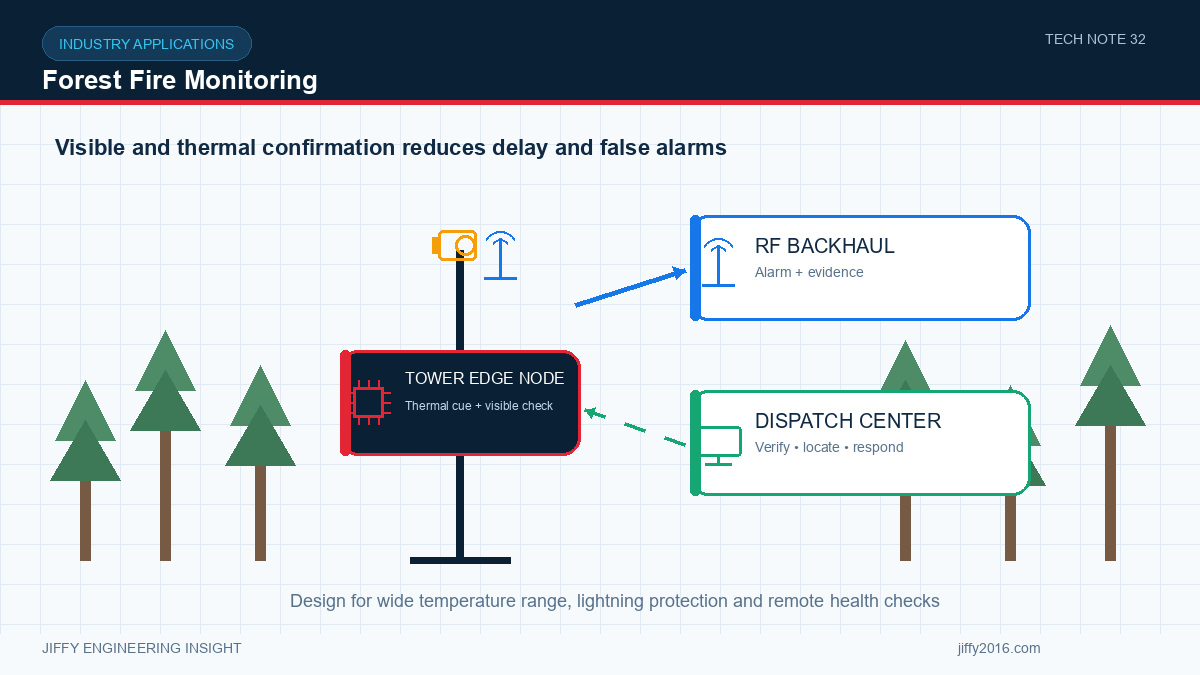
Quick answer: A forest fire monitoring system should combine wide-area visible imaging, thermal cues, edge analysis and reliable RF backhaul. The edge node detects candidate events and sends compact evidence for human or central verification, while storing data during network interruption. Reliable deployment requires careful line of sight, lightning and power protection, seasonal testing, false-alarm analysis and remote health monitoring.
Early fire monitoring is a wide-area observation problem with difficult environmental variation. Sun reflections, haze, clouds, industrial activity and seasonal changes can resemble smoke or heat anomalies. A useful system must detect candidates early without creating an unmanageable alarm burden.
The strongest design uses multiple sources of evidence and keeps enough processing at the remote site to reduce network traffic and support continued operation.
- Key Takeaways
- Use visible and thermal channels as complementary evidence, not interchangeable sensors.
- Detect and buffer candidate events at the edge, then transmit prioritized evidence.
- Build the RF path from surveyed terrain, antenna clearance and seasonal conditions.
- Track false alarms by cause and environment, not only as one total number.
- Monitor power, temperature, storage, camera status and link quality remotely.
- Define the Detection Objective
- Visible and Thermal Evidence
- Edge Analytics and Alarm Workflow
- RF Backhaul Design
- Energy and Remote Health
- Input voltage, battery state and charging status
- Internal temperature and thermal alarms
- Camera connection and image freshness
- Storage capacity and write health
- RF link quality, interruptions and reconnect count
- Edge application and model version
- Last successful alarm test
- Validation Metrics
- Backhaul disconnected during an event
- Storage approaching its retention limit
- Low supply voltage
- High enclosure temperature
- Camera or sensor disconnect
- Reboot and configuration recovery
- Interrupted software update
- Frequently Asked Questions
- Can thermal imaging replace visible imaging?
- Is continuous high-resolution streaming required?
- How can false alarms be reduced?
- What should be tested after installation?
- Conclusion
Specify whether the system is intended to detect smoke, flame, abnormal heat, growth over time or a combination. Define target distance, minimum event size, required confirmation time and operator response.
These requirements determine field of view, optical zoom, thermal resolution, scan strategy and number of observation sites. A camera that covers a larger area does not necessarily provide enough pixels on a distant event.
Establish zones of interest and exclusion. Roads, chimneys, reflective water, industrial heat sources and known controlled activities may require separate rules.
Visible imaging can identify smoke shape, color, movement and environmental context. Thermal imaging can identify temperature contrast, especially when visible light is limited. Neither channel eliminates the need for validation.
Thermal performance depends on target contrast, atmospheric path, lens, sensor sensitivity and image processing. Visible performance depends on illumination, haze, exposure and scene contrast. A combined decision can reduce false alarms when both channels observe a consistent event.
If cameras move or scan, record the position associated with every image. When two sites view the same event, their bearing information can support location estimation, but alignment and geographic calibration must be maintained.
The edge node can perform image stabilization, region masking, candidate detection, temporal filtering and event recording. It should send enough evidence for verification: a key frame, short clip, thermal view, timestamp, camera direction and confidence information.
A practical workflow is:
1. Detect a candidate in one or more channels.
2. Compare it with exclusion zones and temporal history.
3. Record pre-event and post-event evidence.
4. Send the alarm and compact evidence immediately.
5. Allow an operator or central system to request a live stream.
6. Continue local recording if the backhaul is unavailable.
The analytics threshold should be evaluated across seasons and weather. An algorithm tuned on clear summer data may behave differently with snow, fog, leaf changes or low sun angles.
Remote towers often depend on point-to-point or managed multi-site RF links. Survey terrain and vegetation, including future tree growth. Antenna height and Fresnel-zone clearance can determine availability more strongly than nominal transmitter power.
Prioritize alarm metadata and images over background video. Define how the node handles long outages and how stored data is synchronized after recovery. A reconnect should not delay a new alarm.
Use grounding, surge protection and lightning protection practices appropriate to the site and local requirements. Long exposed cable runs need special attention.
Where grid power is unavailable, calculate a seasonal energy budget for cameras, heaters, edge computing, radios and movement mechanisms. Low temperature affects batteries, while high solar loading raises enclosure temperature.
The remote platform should report:
Periodic test events and image-quality checks help identify a dirty window or misaligned camera before a real incident.
Measure detection probability and response time by distance, event type and environmental condition. Measure false alarms by source: cloud, glare, dust, vehicle, chimney, weather or unknown.
Also test system behavior:
Usually the channels are more valuable together. Thermal cues may identify heat contrast, while visible video provides context for verification and response.
Not always. Edge detection with event clips and operator-requested live video can reduce bandwidth and energy use. The operational response requirement should determine the policy.
Use temporal filtering, exclusion zones, multi-sensor evidence and a dataset representing seasons and weather. Review false alarms by cause and update thresholds under version control.
Verify camera coverage, image detail, thermal response, antenna path, alarm delivery, offline storage, power recovery and remote health reporting at the installed site.
Forest fire monitoring requires more than a long-range camera. It requires a verified chain from sensing and edge detection through RF backhaul, evidence review and maintenance.
Jiffy supports visible and thermal camera modules, RF links and edge computing platforms for remote monitoring equipment. Contact sales02@jiffy2016.com for architecture and customization discussions.
Discuss your system requirements with Jiffy
market@jiffy2016.com | www.jiffy2016.com
Subscribe to Our Newsletter
Your Email*
*Country*
*Verification code


