
Remote Site Connectivity - How to Balance Power, Video and Backhaul
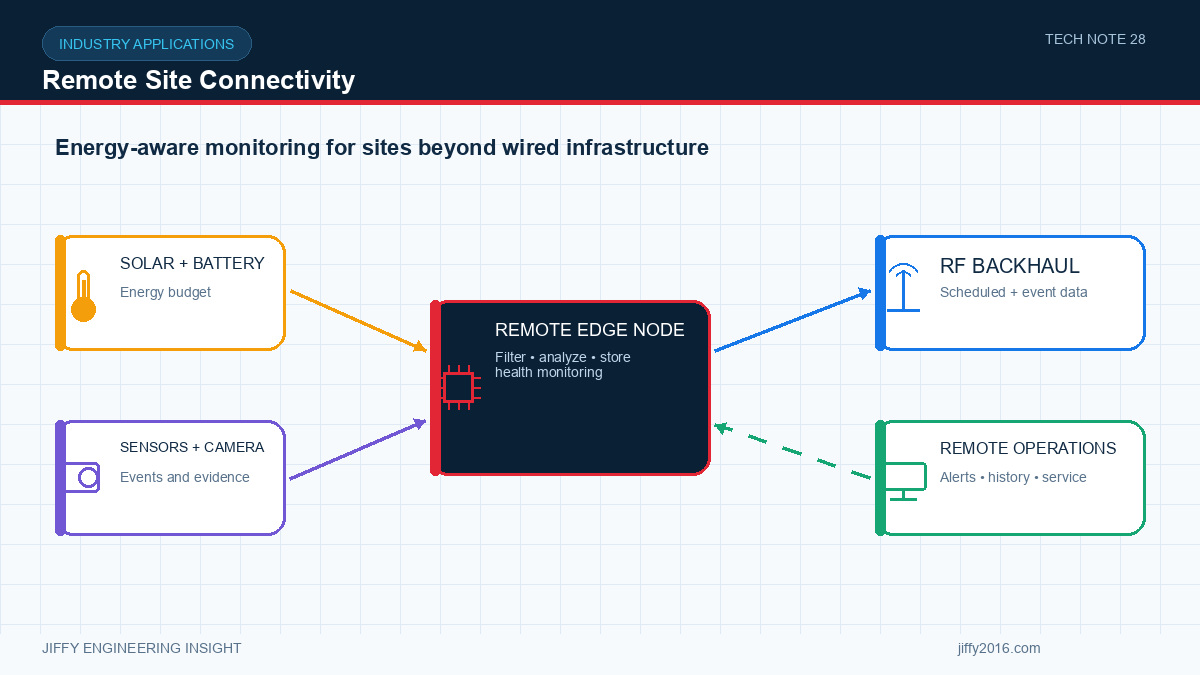
Quick answer: A reliable remote monitoring site combines an energy budget, local edge processing, resilient storage and a backhaul strategy that prioritizes alarms and health data. The site should continue collecting useful evidence during a network outage and synchronize data after recovery. Validation must include seasonal power availability, worst-case temperature, antenna path clearance, storage retention and remote fault diagnosis.
Remote monitoring systems are frequently described as a camera plus a radio. In reality, the limiting resource may be energy, maintenance access, storage or environmental tolerance rather than the communication link itself.
The system should be designed around unattended operation. That means it must detect faults, preserve essential data during interruptions and recover without requiring a technician for every event.
- Key Takeaways
- Build the energy budget from the complete operating profile, including startup and transmit peaks.
- Use edge processing to reduce backhaul traffic and preserve local operation.
- Prioritize alarms and device health over bulk video transfer.
- Size local storage for the expected outage, not only the normal upload schedule.
- Design for remote diagnosis, controlled updates and automatic recovery.
- Define the Site Duty Cycle
- Use Edge Processing to Control Data Volume
- Design the Backhaul from the Path
- Plan for Network Outages
- Environmental and Electrical Protection
- Remote Maintainability
- Input voltage and battery condition
- Internal temperature
- Camera and sensor status
- Storage use and health
- RF link quality and reconnect count
- Application and firmware version
- Last successful event upload
- Field Acceptance Checklist
- Verify target image quality at the installed distance.
- Measure energy consumption in each operating mode.
- Confirm RF performance under normal and reduced link margin.
- Disconnect the backhaul and verify local recording and alarms.
- Fill storage to the defined threshold and confirm retention behavior.
- Cycle power and confirm automatic restart to the approved state.
- Run at expected temperature extremes where practical.
- Confirm a remote operator can identify the source of a simulated fault.
- Frequently Asked Questions
- Is a higher-capacity radio always better?
- How much fade margin is required?
- Should all event video be stored centrally?
- What reduces maintenance visits most effectively?
- Conclusion
The energy requirement depends on when and how each function operates. A camera may run continuously, on a schedule or only after a sensor event. A radio may maintain a low-rate management connection and transmit high-rate video for short intervals. Edge processing may be continuous or event driven.
Create an operating table for every load:
| Load | Active Power | Standby Power | Daily Active Time | Startup Peak |
|---|---:|---:|---:|---:|
| Camera and illumination | Project value | Project value | Project value | Project value |
| Edge processor | Project value | Project value | Project value | Project value |
| RF link | Project value | Project value | Project value | Project value |
| Heater, fan and accessories | Project value | Project value | Project value | Project value |
Add conversion losses, battery aging and temperature effects. Solar sites must be sized from the least favorable seasonal energy condition, not the annual average.
Sending every raw or high-bitrate stream to a distant control center wastes energy and network capacity. The edge node can perform event detection, image selection, encoding, local storage and data summarization.
A practical traffic hierarchy is:
1. Critical alarm and fault status
2. Device health and low-rate telemetry
3. Event image or short event clip
4. Requested live video
5. Background synchronization and software packages
This hierarchy should be implemented in queues or quality-of-service policies so that a large file transfer cannot delay an alarm.
For an RF link, antenna position and path clearance have more value than a theoretical range claim. Survey terrain, structures, vegetation and seasonal changes. A link that clears an obstruction in winter may be degraded by foliage in summer.
The link budget should include transmit power, cable loss, antenna gain, free-space and obstruction loss, receiver sensitivity and a planned fade margin. Confirm permitted frequencies and power levels for the target market and installation.
At installation, record antenna type, orientation, cable length, connector condition, received signal metrics and test throughput. These records provide a baseline for future maintenance.
The edge node should have an explicit offline mode. Decide which events are stored, how long data is retained, what happens when storage becomes full and which data is synchronized first after reconnection.
Use a robust file system and avoid uncontrolled power removal during writes. Where possible, monitor storage health and reserve space for system logs and critical events. A full disk should not stop device management or alarm generation.
Recovery behavior also matters. When the link returns, the node should not overload it by uploading all stored data at once. Throttle synchronization and keep current alarms at the highest priority.
Remote cabinets face temperature extremes, condensation, insects, dust, corrosion, lightning exposure and long cable runs. The enclosure rating alone does not solve thermal or moisture problems.
Provide appropriate grounding, surge protection and cable entry. Separate noisy power conversion from sensitive RF and camera interfaces. Check startup at low temperature, continuous processing at high temperature and recovery after repeated power cycling.
If a heater or fan is used, include its fault state in health monitoring. A temperature sensor inside the enclosure helps distinguish a radio problem from a thermal problem.
The operations platform should report at least:
Use controlled configuration profiles and signed or otherwise authenticated update packages appropriate to the system. Keep a known-good rollback image and verify update behavior over a limited-bandwidth link.
No. A higher data rate may increase energy use or require more link margin. Select the radio from required traffic, path conditions, availability and power budget.
It depends on frequency, path, climate and availability target. Use a documented link budget and validate the installed path over representative conditions.
Important evidence should be transferred according to policy, but local storage remains valuable during outages. Define retention at both locations and test synchronization.
Good health telemetry, controlled restart behavior, configuration records and a reliable power system. Remote access is useful only when the device can report what failed.
Remote site connectivity is a resource-allocation problem across power, computing, storage and communications. A resilient design keeps essential functions local, transmits information by priority and makes field condition visible to the maintenance team.
Jiffy provides RF modules, wireless video products, camera modules and edge computing boards for remote industrial systems. Contact sales02@jiffy2016.com to discuss architecture and interface requirements.
Discuss your system requirements with Jiffy
market@jiffy2016.com | www.jiffy2016.com
Subscribe to Our Newsletter
Your Email*
*Country*
*Verification code


