
Thermal Design for Continuous Edge Inference and Video Encoding
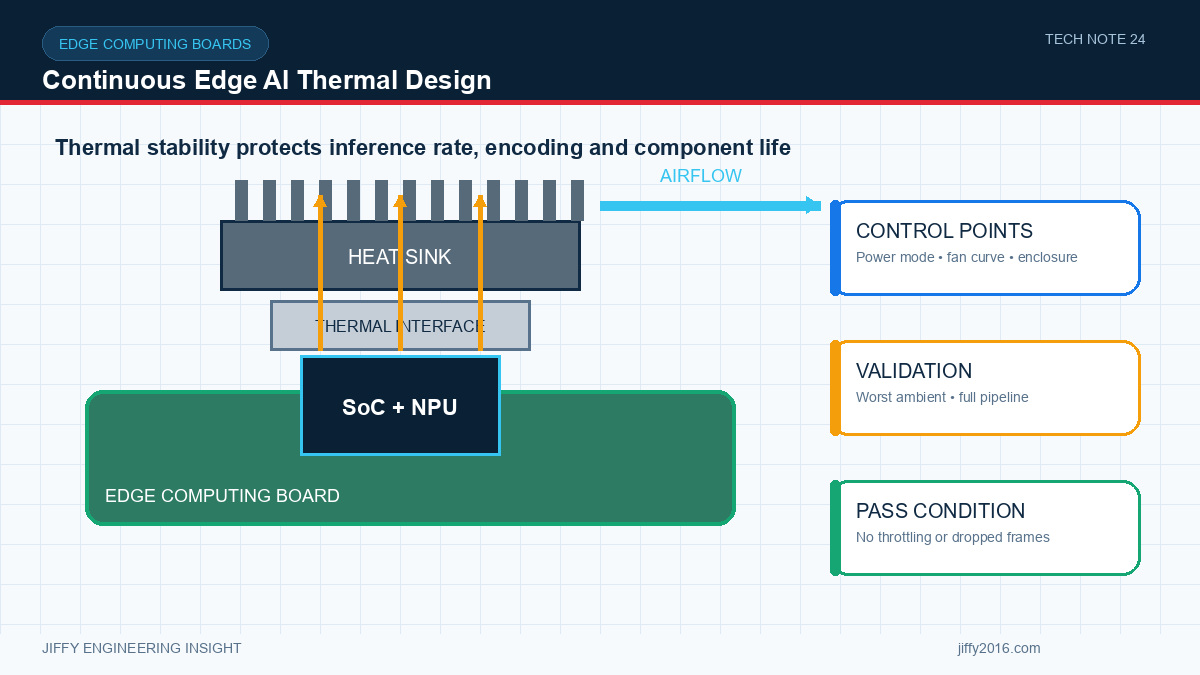
Quick answer: Edge AI thermal design must remove heat from the processor, NPU, memory, power stages and storage while cameras, inference, codecs and networking run together. Validate the final heatsink, interface material, enclosure, orientation and airflow at target ambient until temperatures stabilize, while monitoring clocks, throttling, frame rate and inference latency.
An edge platform can pass a short demonstration and slow down after heat accumulates. Thermal validation must therefore measure application performance over time, not only component temperature during a brief benchmark.
- Key Takeaways
- Use the complete production workload as the heat source.
- Monitor performance counters as well as temperature.
- Include memory, power conversion and storage in the thermal review.
- Validate final mounting, airflow and enclosure orientation.
- Define a predictable response to blocked airflow or high ambient temperature.
- Build the workload profile
- Identify heat sources
- Design the thermal path
- Monitor throttling and performance
- Enclosure and ambient testing
- Fault behavior
- Validation checklist
- Complete camera, AI, codec, storage and network load running
- Final heatsink, interface and enclosure installed
- Target ambient and orientation represented
- Processor, memory, power and storage temperatures observed
- Clock and throttling state logged
- Frame rate, latency and dropped frames tracked
- Power input measured over time
- Blocked-airflow or high-temperature response tested
- Long-duration stability demonstrated
- Assembly method and thermal materials documented
- FAQ
- Is staying below a temperature limit enough?
- Can a short stress test approve the design?
- Should thermal tests use a synthetic benchmark?
- Conclusion
List camera inputs, image-processing stages, AI models, inference rates, codecs, display, network and storage activity. Identify continuous and burst conditions. The maximum processor load may differ from the maximum combined board heat.
Use representative scenes because codec and AI load can vary with content.
The main processor is not the only source. Memory, storage, interface devices, power converters and camera supplies contribute. Components can heat each other through the PCB and enclosure.
Record sensor locations and understand which physical areas they represent. An internal sensor may not report the hottest external power component.
Define contact from processor package or spreader through interface material to heatsink or chassis. Check flatness, pressure, material thickness and assembly tolerance.
If airflow is used, specify minimum flow, direction, inlet temperature, blockage and maintenance. Avoid relying on an open bench fan that is absent from the product.
Record clock frequencies, utilization, temperature, inference time, frame rate, codec performance, dropped frames and power. A stable temperature caused by aggressive throttling is not a passing result if application performance falls below requirements.
Observe the transition into and out of thermal control. Rapid cycling can create variable latency.
Test the closed production enclosure in its intended orientation. Include sun load, nearby equipment heat or restricted airflow when relevant. Continue until the thermal and performance trend stabilizes.
Repeat start, stop, reconnect and model-load cycles at warm conditions because state transitions can create additional peaks.
Define warnings, workload reduction, controlled shutdown and recovery. Preserve logs that show which limit was reached. If the system reduces inference rate or video quality, the application should know the current operating mode.
Test fan failure or airflow blockage where applicable, using safe controlled methods.
No. The system must also sustain required frame rate, inference latency, codec and network performance without unacceptable throttling.
No. The final enclosure may take much longer to reach thermal equilibrium.
A benchmark can help characterize a component, but final approval should use the production application workload and representative scenes.
Edge AI cooling is approved when the complete workload remains stable at the target ambient without hidden performance loss. Measure temperature, clocks and application output together in the final assembly.
Discuss your system requirements with Jiffy
market@jiffy2016.com | www.jiffy2016.com
Subscribe to Our Newsletter
Your Email*
*Country*
*Verification code


