
How to Estimate Memory and Network Bandwidth for Multi-Camera Edge AI
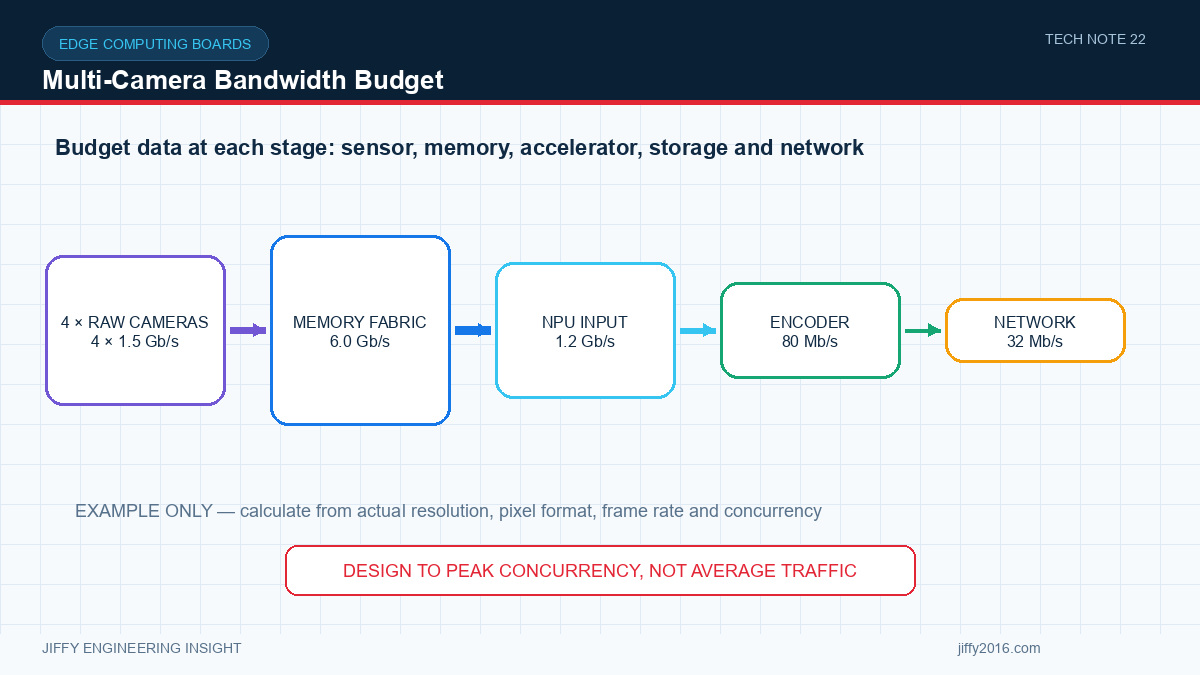
Quick answer: Multi-camera edge AI bandwidth must be calculated at each stage, not only at the network output. Estimate raw sensor input from resolution, frame rate and pixel format; then include image processing, scaling, memory copies, encoding, AI preprocessing, storage, display and protocol overhead. Validate the complete workload because shared memory and internal copies can become the limit.
Four compressed output streams may appear small while the internal system moves much larger raw frames through camera interfaces, memory, image processing and AI. Capacity planning should follow every copy and conversion from sensor to destination.
- Key Takeaways
- Raw camera bandwidth is much larger than compressed output bitrate.
- Memory traffic can multiply when frames are copied, scaled or converted.
- Codec bitrate varies with scene detail and motion.
- AI preprocessing and model input add independent data movement.
- Test all pipelines together with representative scenes.
- Calculate raw camera input
- Map image-processing stages
- Account for memory bandwidth
- Estimate encoding load
- Add AI preprocessing and inference
- Network and storage
- Planning worksheet
- Camera format and raw input rate per channel
- Number and size of capture buffers
- ISP outputs and scaled copies
- AI input size, rate and number of models
- Encoded average and peak bitrate
- Display or compositor load
- Storage write rate and retention behavior
- Network protocol overhead and simultaneous clients
- Maximum memory use and queue depth
- Dropped-frame and latency acceptance limits
- FAQ
- Can compressed bitrate be used as the camera input bandwidth?
- Why do frames drop when processor usage is not high?
- How much headroom is enough?
- Conclusion
Begin with active width, height, frames per second and bits per pixel at the camera interface. Include protocol or blanking overhead when it matters to the interface capacity.
Calculate every camera separately if formats differ. Record lane count, link rate and which physical interface carries each stream.
Image signal processing may demosaic, denoise, correct color, scale and convert formats. Each stage can read and write full frames. If an application requests several resolutions from one camera, the system may create additional buffers.
Draw the actual path and identify whether hardware blocks share buffers or require copies through system memory.
Memory load includes camera capture, processor access, graphics, AI accelerator input, codec, display and storage buffers. Theoretical memory-interface bandwidth is not equal to sustainable application bandwidth because arbitration, access pattern and other system activity consume capacity.
Monitor counters and dropped frames during the full workload rather than approving from arithmetic alone.
Compressed bitrate depends on resolution, frame rate, codec, quality setting, key-frame interval and scene complexity. A static bench scene can hide peaks that appear with motion, texture, rain or changing illumination.
Record average and peak output over representative scenes and leave network and storage headroom.
Models may require resize, crop, color conversion, normalization and layout changes. These operations use processing and memory even before inference begins. If several models or regions run per frame, include each path.
Measure complete capture-to-result latency and model throughput while encoding and networking remain active.
Add video streams, metadata, control traffic, container overhead, retransmissions and file-system behavior. Storage writes may be bursty because of buffering. Network throughput should be measured at the application layer, not inferred only from interface line rate.
Test slow receiver, disconnected network, full storage and file rotation.
No. Compression normally happens after raw frames have already entered and moved through the platform.
Memory bandwidth, interface limits, buffer starvation, codec or storage can be limiting even when CPU use is moderate.
It depends on workload variation and recovery requirements. Measure representative peaks and choose margin through system testing rather than a universal percentage.
Multi-camera capacity is a data-path problem. Calculate raw input, internal movement and compressed output separately, then validate all cameras, codecs, AI, storage and networking together.
Discuss your system requirements with Jiffy
market@jiffy2016.com | www.jiffy2016.com
Subscribe to Our Newsletter
Your Email*
*Country*
*Verification code


