
Low-Light Imaging - Balancing Exposure, Motion Blur and Noise
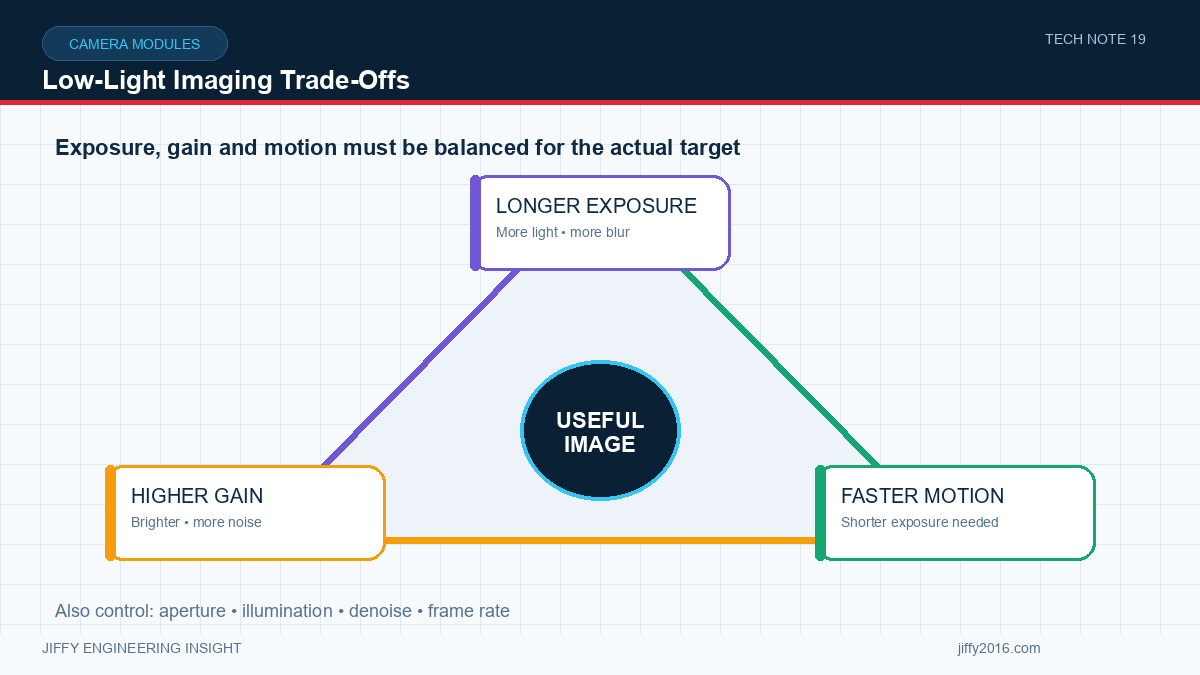
Quick answer: Low-light imaging is a trade-off between collected light and scene motion. A longer exposure gathers more light but increases motion blur; higher gain brightens the signal but also amplifies noise; a wider aperture gathers light but changes depth of field. The correct settings depend on target speed, required detail, lens, frame rate and lighting.
A bright image is not necessarily a useful image. If the exposure is too long, moving features blur. If gain is too high, noise removes detail and can reduce AI accuracy or increase compression bitrate.
- Key Takeaways
- Define target motion and required detail before tuning brightness.
- Set exposure from allowable motion blur.
- Add optical light before relying on excessive electronic gain.
- Evaluate noise reduction for detail and latency effects.
- Test with production lens, enclosure and illumination.
- Exposure time
- Gain and noise
- Aperture and lens
- Add controlled illumination
- Image processing
- Test matrix
- Minimum and typical illumination
- Stationary and maximum target speed
- Near and far working distance
- Dark and reflective surfaces
- Exposure and gain limits
- Frame rate and codec settings
- Noise-reduction levels
- Supplemental-light states
- Enclosure window and temperature
- Human and algorithm acceptance results
- FAQ
- Why is a low-light image bright but still unclear?
- Does a larger sensor always solve low light?
- Can software remove all image noise?
- Conclusion
Exposure determines how long the sensor collects light for each frame. Longer exposure increases signal but also integrates target movement. Estimate how far the smallest relevant feature moves during one exposure and decide whether that blur is acceptable.
Frame rate does not automatically define exposure; confirm the actual exposure limit and automatic-control behavior.
Analog and digital gain can brighten the image, but they cannot create signal that was not captured. Higher gain increases visible noise and can reduce dynamic range. Temporal noise may also create additional encoder traffic or false AI features.
Record gain limits used in automatic exposure. Avoid allowing the camera to reach an unusable high-gain state simply to maintain a target brightness.
A wider aperture passes more light but reduces depth of field and may change edge performance. Lens transmission and sensor compatibility matter, not only f-number.
If focus distance varies, validate near and far targets at the selected aperture. Check enclosure windows for reflection or light loss.
Supplemental visible or infrared lighting can improve signal-to-noise ratio and permit shorter exposure. Review wavelength response, eye and operational safety, reflections, flicker, power and thermal load.
Place light to reduce glare and shadows for the actual target surface. Automatic lighting changes should not create unstable exposure loops.
Spatial and temporal noise reduction can clean the image but may soften detail, smear motion or add delay. Sharpening can increase apparent detail while also emphasizing noise.
For AI inference, validate the processed output with the actual model. A setting preferred by a human viewer may not be best for an algorithm.
High gain or long exposure can increase brightness while adding noise or blur. Evaluate target detail, not average brightness.
It can help, but lens, pixel size, exposure, motion, processing and product constraints still determine performance.
No. Aggressive processing may remove real detail or add delay. Capture adequate optical signal first.
Useful low-light imaging begins with the maximum acceptable blur and required detail. Balance exposure, gain, optics, lighting and processing, then validate the complete task under the darkest realistic condition.
Discuss your system requirements with Jiffy
market@jiffy2016.com | www.jiffy2016.com
Subscribe to Our Newsletter
Your Email*
*Country*
*Verification code


