
What Thermal Sensitivity Means in a Real Inspection Scene
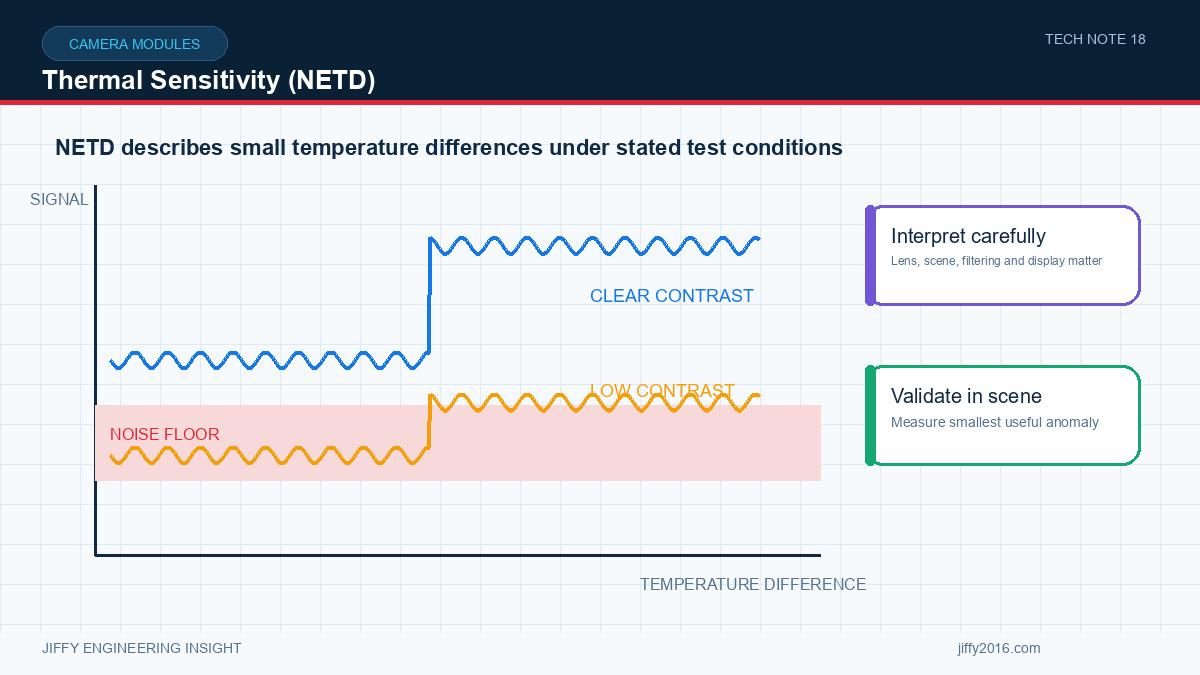
Quick answer: Thermal sensitivity describes how small a temperature-related signal difference a thermal imaging system can distinguish under defined conditions. NETD is a common laboratory metric, but real inspection performance also depends on optics, target size, distance, emissivity, reflections, calibration, scene temperature, image processing and environmental stability.
A lower sensitivity value can indicate the ability to display finer temperature contrast, but it does not guarantee accurate temperature measurement or successful detection of every target. Selection should begin with the inspection decision and real scene.
- Key Takeaways
- NETD is a controlled metric, not a complete application result.
- Detection, recognition and temperature measurement have different requirements.
- The target must occupy enough detector pixels.
- Surface emissivity and reflections can dominate apparent temperature.
- Validate with representative targets and operating conditions.
- What is NETD?
- Sensitivity versus accuracy
- Target size and distance
- Surface and environment
- Image processing
- Validation checklist
- Inspection decision and target temperature range defined
- Target size, distance and angle documented
- Detector and lens configuration fixed
- Emissivity and reflected environment considered
- Protective window transmission verified
- Processing and display range controlled
- Normal and abnormal samples collected
- Repeatability tested after warm-up and environmental change
- Alarm or algorithm result checked against the real decision
- FAQ
- Does a lower NETD guarantee more accurate temperature?
- Why does shiny metal show unexpected hot or cold areas?
- Can a small hot spot be detected at any distance?
- Conclusion
Noise-equivalent temperature difference represents the temperature difference that produces a signal comparable to system noise under specified conditions. Lower values generally indicate finer temperature contrast, but comparisons require consistent test conditions, optics, frame rate and processing.
Ask for the measurement conditions when comparing values. A number without context may not describe the delivered camera configuration.
Sensitivity concerns resolving small differences; accuracy concerns how close a reported temperature is to the true target temperature under a defined method. A camera may show fine contrast while absolute measurement remains affected by emissivity, reflected temperature, distance and calibration.
Define whether the task needs relative pattern change, threshold detection or traceable temperature measurement.
A small hot spot that covers less than one detector element is averaged with its surroundings. The apparent contrast can decrease even when the sensor is sensitive.
Choose detector resolution and lens so the target occupies enough pixels for the decision. Validate at the maximum working distance and expected viewing angle.
Shiny metal can reflect thermal radiation from people, sky, equipment or heaters. Low-emissivity surfaces can produce misleading apparent temperatures. Air path, protective windows, dust, moisture and rapidly changing ambient conditions can also affect results.
Use representative materials and mounting. Ordinary visible-light glass may not transmit the thermal band used by the camera.
Noise reduction, sharpening, temporal averaging and automatic range adjustment can make an image easier to view but can also change temporal response or apparent detail. Record processing settings used for validation.
For automated analysis, use stable output and understand whether the application receives display-mapped imagery or measurement data.
No. Sensitivity and measurement accuracy are related to different aspects of performance.
It may reflect surrounding thermal radiation. Review emissivity, viewing angle and reflected sources.
No. Target pixels decrease with distance. Lens, detector resolution and required decision determine the useful range.
Thermal sensitivity is valuable when interpreted with target geometry, optics, surfaces, environment and processing. Approve the configuration using representative scenes instead of one isolated metric.
Discuss your system requirements with Jiffy
market@jiffy2016.com | www.jiffy2016.com
Subscribe to Our Newsletter
Your Email*
*Country*
*Verification code


